
Mountain railways
For a long time, ascending a summit without any effort was impossible for those who were not mountaineers. Closely linked to a growing fascination for altitude among the bourgeois elite, the construction of mountain railways was decisive in the boom in mountain tourism. In the 1880s, this rush to reach the summit was marked by the proliferation of installations using technical systems designed to ensure complete safety.
Altitude: a technical challenge
During a stay in Switzerland in 1891, Mark Twain was struck by the number of railway structures (mountain railways, rack railways, and funiculars) that criss-crossed the Alps in every direction. “There isn’t a mountain in Switzerland now that hasn’t a ladder railroad or two up its back like suspenders […] and the peasant of the high altitudes will have to carry a lantern when he goes visiting in the night to keep from stumbling over railroads that have been built since his last round”. (Twain, 1963, pp. 110–119). The American writer’s astonishment could be extended to many other summits in Europe and the rest of the world, as mountains increasingly served to satisfy the desires of tourists eager to ascend them without danger, much to the dismay of Alpine clubs. For the beauty of the spectacle once conquered, they indulge to every excess, fuelling the most disproportionate ambitions.
By no longer allowing climbers alone the possibility to conquer the mountains, these modes of transport owed their existence to engineers’ ability to tackle ever-steeper slopes. From the very beginnings of railway, engineers were immediately confronted with the problem of gradients. Their calculations led them to limit wheel adhesion to slopes with a gradient of no more than 5%. Beyond this limit, the undertaking became arduous and dangerous, but not impossible. Intensive efforts were undertaken to find solutions to overcome these obstacles. With the boom in mountain tourism, the issue became increasingly urgent, as tourists were fascinated by summits reached only by daring mountaineers, who readily recounted their feats in publications popular with the general public. This “why not us too?” resulted in solutions as ingenious as they were improbable. Several systems gradually proved effective and reliable.
Plurality of systems
A rack railway uses a third rail with teeth at the centre of the track, enabling one or more driving wheels to be powered by a gear mechanism. Several systems appeared from the late 1860s onwards, most of them the product of Swiss engineering. The Vitznau-Rigi line was the first rack railway in Europe to demonstrate the reliability of the rack railway for tourist purposes. Built based on the system developed by Niklaus Riggenbach, it was inaugurated with great ceremony on 21 May 1871 and quickly became an internationally famous attraction, with access further facilitated by the opening of the Gotthard Tunnel ten years later. Riggenbach continued his construction projects elsewhere in Europe. The main advantage of the rack system is that it can be installed along part of a standard line at points where the gradient becomes too steep.
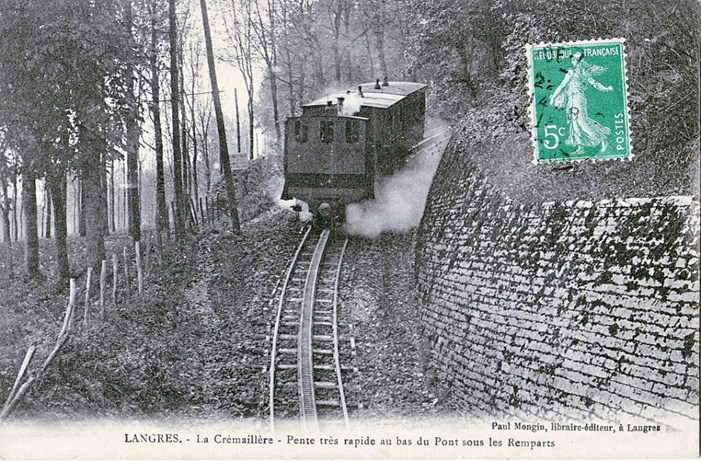
Ill. 1- The Langres rack railway, based on the Riggenbach system, inaugurated in 1887.
https://fr.wikipedia.org/wiki/Liste_des_chemins_de_fer_%C3%A0_cr%C3%A9maill%C3%A8re#/media/Fichier:LANGRES_-_La_cr%C3%A9maill%C3%A8re_-_Pont_sous_les_remparts.JPG (consulté le 10 mars 2023)
With the funicular, the mountain also became an object of leisure, combining dreams, excitement, and domination. Known since the Middle Ages and used in mining during the 19th century, the funicular, generally consisting of two carriages, driven by one or more cables. The weight of the descending car partially counterbalances that of the ascending one. The energy required can be supplied using various means, such as steam power, an electric motor, and also so-called water-counterweight systems. In the latter case, water from a stream or another source (including wastewater) is directed into a reservoir, causing one car to descend while the other car is pulled upwards. Another Swiss engineer, Carl Roman Abt, developed a system first installed at Giessbach in 1879, used to connect the landing stage on the shores of Lake Brienz (566 metres) to a station near the Grandhotel (656 metres), built five years earlier. Abt would go on to direct numerous rack railway and funicular projects in Europe and elsewhere.
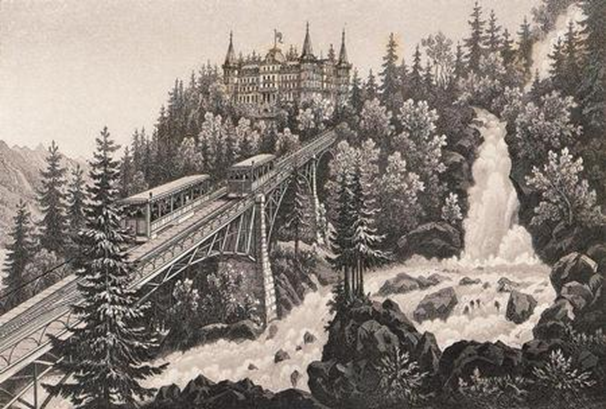
Ill. 2 – View of the Grand-Hôtel at Giessbach on Lake Brienz, with the waterfall and the funicular. One of Abt’s innovations was installing a passing loop halfway along the route.
Aquatint by Johann Rudolf Dikenmann, c. 1883 (Swiss National Library).
The popularisation of these new attractions continued to depend on technical devices designed to guarantee complete safety to reassure a clientèle unaccustomed to steep drops or travelling over voids. Advertising quickly seized upon this opportunity to present the mountains as completely safe. Thus, the viewpoint’s beauty featured prominently in posters and other promotional materials. Placed in the hands of engineers, altitude was no longer a leisure activity reserved for a few daring climbers, but an attraction available to those who could afford it, initially limited to a wealthy minority before being sold to a wider audience.
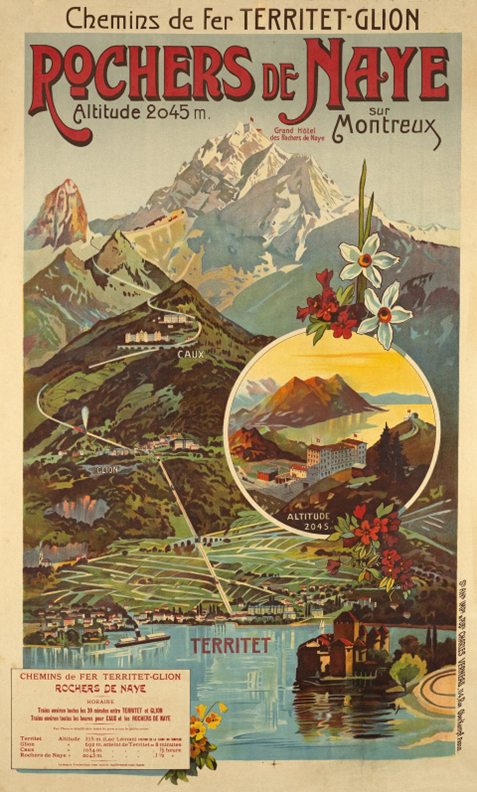
Ill. 3 – Anton Reckziegel, Territet–Glion Railways, 1903 © Alpine Museum in Bern.
Laurent TISSOT
Bibliography
- Twain Mark, « Switzerland, the Cradle of Liberty », in: The Complete Essay of Mark Twain, New York, 1963, pp. 110‑119.