
Colonisation and tourism
Tourism in the colonies (19th-20th centuries)
Tourism development in Africa, parts of Asia, and Oceania does not date to the post-colonial period, but began when these territories were under the domination of Western empires (and, more briefly, the Japanese empire) In this respect, tourism was an integral part of the colonial undertaking, which made its emergence possible from the mid-19th century onwards in the oldest colonies (India and Algeria, for example). In turn, tourism helped legitimise the so-called civilising mission of the dominant powers (Baranowski et al., 2015). Based on a racialised vision of people, it also played a role in the heritage recognition of the historical and natural sites in the colonised territories. The will of the authorities to make it a profitable resource and open it up to the middle classes soon came up against the historical context (Great Depression of 1929, Second World War, and decolonisation movements).
Indeed, different forms of tourism existed before the colonial period, specifically pilgrimage-based travel (as in India and the Muslim world). Furthermore, Egypt had already attracted tourists before the Suez Canal’s inauguration in 1869, while hotels were opening in Cairo and Alexandria (Anderson, 2012). Nevertheless, it was colonisation that enabled the forms of tourism developed in Europe in the 19th century to be exported to these territories.
Tourism and colonisation
On the one hand, the colonial army and administration provided the order necessary for tourism development. Tourists seek security and comfort. Thus, tourism developed once resistance to colonisation had been brought under control in the regions concerned, such as in Algiers from the 1860s onwards (in the form of winter tourism), but also in East Africa from around 1905 (present-day Kenya); or in Bali following the repression of local opposition and the introduction of the “Ethical Policy” in the Dutch East Indies. While the army ensured security, the colonial administration also offered tourists a familiar and reassuring setting. Travellers were thus able to discover colonised territories without risk, discovering part of their own environment on site, even their language (or at least a European language if travelling in a different empire).
Tourism also benefited from the development of transport infrastructure, which increased connections between the mainland and the colony. The first half of the 19th century saw the boom in steam navigation and the rise of major shipping companies, such as the British firm P&O (Peninsular and Oriental Steam Navigation Company), French companies such as the Compagnie Générale Transatlantique (Transat) and the Messageries Maritimes, and Dutch operators such as the KPM (Koninklijke Paketvaart Maatschappij). In 1844, P&O pioneered the cruise, enabling several dozen tourists to discover the Mediterranean on the way from London to Cairo. At the end of the 19th century, the principle of travel, including transport, hotel reservations, and sometimes excursions from European capitals to destinations such as Algeria, and Tunisia, and cruises to Egypt, later to the Dutch East Indies, became more widespread. Shipping companies also created hotels (such as KPM did in Denpasar in 1928) and even genuine hotel networks (Wijaya & Sulistiyono, 2020). Thus, Transat, through its subsidiary La Société des voyages et hôtels nord-africains, built about twenty hotels along Saharan routes in the Maghreb during the 1920s and 1930s.
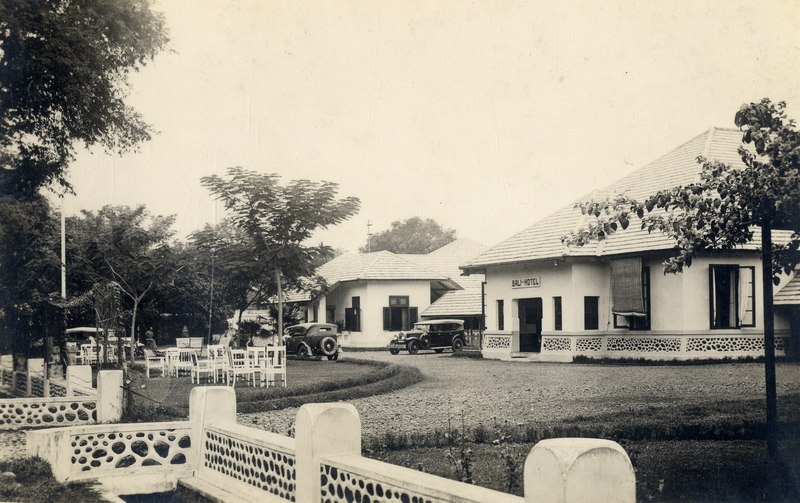
Ill.1 Bali-Hotel te Denpasar. Source: Bibliothèque universitaire de l’université de Leiden
Within the colonies themselves, the train was also a tool for tourism development. The success encountered by the hill stations in Bengal was reinforced by the opening of the Darjeeling Himalayan Railway in the 1880s (Sacareau, 2012). In Indochina, construction of the line between Dalat and Thap Cham from 1908 to 1932 contributed to Dalat’s relative boom as a resort. With the advent of cars, yet another form of tourism emerged, following the automobile “cruises” initiated by Citroën in the 1920s. The Saharan road network, scattered with hotels and halts used by the empire’s officials and tourists, became the backbone of the French Empire, the quintessential imperial route (Zytnicki, 2016). In the 1930s, photography safaris in Kenya attracted a slightly broader audience than the wealthy hunters who had made the region famous before 1914 (Simmons, 2015). During these years, and especially after the Second World War, tourism also benefited from the boom in aviation, with major airlines whose histories were themselves closely tied to the empire: Air France, Imperial Airways and Sabena. Admittedly, tourist flows were still limited, and it was difficult to distinguish tourists from other types of travellers.
Who were the tourism players in the colonies?
The role of colonial political authorities
As for Europe, it was not until the early 20th century that States began to take an interest in tourism. From the 1910s, and above all the 1920s, governors-general in Algeria, such as Charles Lutaud and Charles Jonnart (the latter even envisaged the development of tourism in the Aurès region, which was shaken by a revolt in 1916), and Albert Sarraut in Indochina, became its advocates (Demay, 2011). At the time, tourism was seen as a propaganda tool of the colonial enterprise, one that tourists were expected to acknowledge and celebrate. Japanese authorities, for example, combined their tourism propaganda with invitations to visit sites commemorating the Russian-Japanese War in Manchuria with calls to migrants (L’Hérisson, 2020). It was also a means of attracting settlers to colonies, such as Algeria, or territories intended to become colonies (such as the Italian colony of Libya (McLaren, 2006). Alongside these political and demographic arguments was an economic ambition: tourism could participate in the development of colonies. State-backed organisations bringing together public and private interests to promote tourism had already emerged in the late 19th century, with the Tasmanian Tourist Association in 1894 (which organised trips to the country in cooperation with the Cook Agency), the Vereeniging Toeristenverkeer in Nederlandsch-Indië (or Tourist Association in the Dutch East Indies) from 1908, the OFALAC in Algeria (Office Algérien d’Action Economique et Touristique du Gouvernement Général de l’Algérie), and the Australian National Travel Association, founded in 1929. Colonial administrations forged close ties with transport companies. For both economic (supporting tourism) and geostrategic reasons (securing the trans-Saharan route linking French Equatorial Africa to the Maghreb), the Government General of Algeria took over part of the hotel network developed by the Transat in the Maghreb, which had been affected by the 1929 economic crisis.
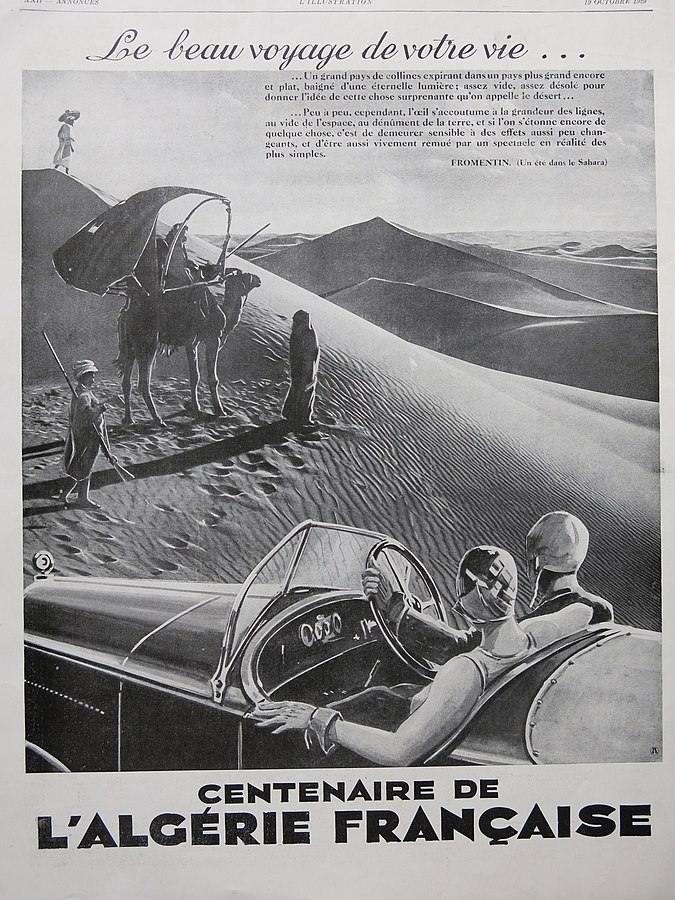
Ill.2 Advert for tourism in Algeria for the centenary of French Algeria (1929).
Private initiatives
Nevertheless, as in Europe, tourism remained primarily a private affair. The emergence of a hotel sector specifically for tourists was largely the result of individual initiatives (the Hotel Saint-George in Algiers in 1889, the Norfolk Hotel in Nairobi in 1904), or of companies such as the Cook Agency, which opened a hotel in Luxor in 1877. To stimulate the sector, comités d’hivernage (wintering committees) and syndicats d’initiative (tourism offices) developed in the late 19th century in Algeria, and later in Tunisia, Morocco, and Indochina, bringing together private interests and local authorities. They did propaganda work for the colony, developed sites, etc. Tourism was also supported by tourist agencies, such as the Cook agency, whose global success was linked to the opening of the Suez Canal in 1869 and whose activities ranged from organising cruises to inventing the traveller’s cheque. Hiking associations, such as the Touring Club in the French, Italian, and later Belgian empires, quickly adapted to the colonial period. These institutions promoted overseas tourism by publishing guidebooks, such as the Guida d’Italia del Touring Club Italiano. Pessedimenti e colonie. Isole Egee, Tripolitania, Cirenaica, Eritrea, Somalie, in 1929 (Strangio, 2021). They also played an essential role in domestic tourism, contributing to the creation of a local identity among settlers forged by the exploration of the land. In British India, entrepreneurs from local merchant castes opened hotels in hill stations and the country’s major cities. It was Jamsetji Nusserwanji Tata, founder of the Tata Group, who commissioned the construction of the Taj Mahal Palace in Mumbai in 1903.
The multitude of local players
Beyond economic interests, other stakeholders also played a role in the development of tourism in the colonies. In Kenya, from the early 20th century onward, settlers, known as White Hunters, accompanied foreign hunters on safaris. The colonial elite, organised within learned societies in Maghreb (the Comité du Vieil Alger in Algiers, the Société de Carthage in Tunis) or Bali, defended the local heritage by highlighting its tourism value. Tourism also relied on Indigenous peoples, who worked as guides, safari porters, and hotel and restaurant staff. Although their positions were subordinate and shaped by discrimination, there were some more positive examples, such as in New Zealand at the end of the 19th century. Tourism development in the Lake Rotomahana region of New Zealand was driven by the local population (Bremmer, 2015).
Tourism propaganda, colonial propaganda
An entire system was deployed by these different players to promote tourism. This involved the publication of guidebooks, either by publishing houses in mainland France (Baedeker, Cook, Murray, Hachette, or Michelin) or produced in the countries. Tourist offices and transport companies commissioned eye-catching posters and did not hesitate to finance trips for famous writers, who were expected to extol the wonders of the empire. Thus, in his novel Clovis Dardentor, Jules Verne promoted the Algerian railway network; the writer William M. Thackeray was invited by P&O to travel to Egypt in 1844. The British royal family also played its role in promoting tourism, with Queen Victoria’s sons travelling around the Empire.
What did tourists come to see?
Almost all forms of tourism were developed within the framework of colonial tourism. Thus, visits to remains of the past can be seen as an early form of cultural tourism. The preservation of ancient Roman sites and visits to them in Tunisia, Algeria, and Libya enabled French and Italian colonisers to present themselves symbolically as a continuation of the Roman Empire. In the 19th century, a policy to preserve local history was implemented. The first heritage law in Morocco dates from 1912, a similar act to the Ancient Monuments Preservation Act of 1904 in British India. In this way, the heritage of colonised populations was, to a certain extent, incorporated into the national heritage, such as the temples of Angkor in Cambodia or the mosques of Algeria. From the 1910s onwards, in Bali, the Dutch government positioned itself as the guardian of local culture, which was staged for tourists who were starting to visit the island through a “Balinisation” (Baliseering) policy (Picard, 2008). In the French Empire, the “African soul” (Dulucq, 2009) was offered to visitors to sub-Saharan Africa, while in Maghreb, a policy aimed at preserving local crafts, such as the carpets of Rabat in Morocco, went hand in hand with efforts to develop tourism.
In Africa and the Pacific, it was the so-called “wild” nature that attracted tourists. Game parks, the oldest of which, Hluhluwe in Zululand, dates back to 1895, were initially designed to regulate animal resources. The following century, the desire to preserve the fauna and flora was formalised in the Agreement for the Protection of the Fauna and Flora of Africa in 1933, and in the creation of national parks, the tourism role of which was clearly asserted (Blanc, 2020). The opening of Kruger National Park in South Africa in 1923 is a testament to this trend. Similar developments were seen in the Belgian Congo, where the first national park was created in 1925, and in Portuguese colonies (Cameia Natural Park in Angola in 1938), often at the cost of the displacement or expulsion of local populations (Davis, 2012).
Finally, the colonised people were also subjected to the gaze and desire of tourists. From sub-Saharan Africa to Asia, sex tourism, absent from official statistics and guidebooks, was nevertheless pervasive. Based on a racialised vision of colonised populations and facilitated by the suspension of everyday constraints experienced by tourists, it is an undercurrent in travel narratives about the Casbah of Algiers or Biskra and its Ouled Naïl dancers. The perfectly organised “reserved” quarter of Bousbir in Casablanca was frequented by tourists passing through (Taraud, 2003).
The tourist gaze and types of tourists
It is important to underscore the racial dimension that shaped both tourist guidebooks and the tourist gaze itself (Chio et al., 2020). Because travelling in the colonies actually meant measuring the divide between populations within a strictly hierarchical vision of humanity. Numerous travel books testify to tourists’ adherence to this vision of the world. Very few voices offered a more critical perspective, such as those of André Gide on the Congo and E. M. Forster on India. Tourists visiting the empires saw very little of reality (or did not want to).
These colonial era travellers represented a tiny elite. This can be explained by the period in which leisure, which required both free time and a good standard of living, was reserved for an aristocratic and bourgeois elite, such as those who wintered in Algiers or Egypt in the 19th century. The development of transport, and above all the introduction of paid holidays in mainland countries, helped to open up tourism to the middle classes. The transition to a form of tourism focused more on the working classes, driven by activist organisations such as Tourisme et Travail, or by more commercial structures such as Club Med, which opened its first canvas village in Djerba, Tunisia, in 1954, only began to take shape after the Second World War.
Tourists were also locals. National parks, hill stations, and spa resorts primarily targeted them. Indian hill stations were initially created between 1820 and 1840 to “regenerate” British colonial officials and settlers in the Himalayan foothills. Over time, health and hygiene ambitions were supplemented by social and political functions (Kenny, 1995). They became the quintessential space for British social exclusivity, with the proliferation of clubs of all kinds. Shimla was even declared the summer capital of the Raj in 1863 and became the summer headquarters of the British Army’s commander-in-chief. In Algeria, a similar concern with regeneration led to the decision to create national parks in 1921 and to the opening of the first of its kind, Teniet el-Haad, in 1923. Locals were also the main target of thermal resorts (which predated colonisation in Maghreb) in Tunisia and Algeria. On the Island of Réunion, the spa town of Cilaos has received visitors since the late 19th century. Similarly, the creation of winter sports resorts (Chréa near Algiers and Ifrane in Morocco), primarily targeted domestic tourism, while seaside resorts began to appear in Tunisia and Algeria. Frequented mainly, though not exclusively, by settlers, they became spaces devoted to a veritable cult of sun and sea, where the identity of Europeans in Algeria was forged.
Colonial tourism: segregation and ethnic discrimination
Tourism did not escape the discrimination that was the norm in the colonies. On the trains leading to the hill stations, first-class carriages were reserved for Whites. However, at the end of the 19th century, the Indian elite began to frequent these resorts and build houses there, combining local and imported architectural features (Mukherjee, 2012). In Algeria, members of the elite joined the Algerian Touring Club before 1914. A phenomenon of mimicry gradually took shape as an upper class emerged in the colonies and appropriated the settlers’ social codes, such as the clubs for Anglo-Indians. However, this appropriation did not eliminate discrimination. In the spa resorts renovated by colonial authorities in Maghreb, ethnic segregation remained the rule.
The place of tourism in colonial societies remained marginal. It did not generate large numbers of travellers – in Bali, for instance, the number of tourists did not exceed 3,000 in the 1930s – nor did it constitute a large-scale economic activity. Nevertheless, it made a mark on post-colonial societies in two ways: by creating sites that have endured over time and by shaping notions about places and people that are still used in modern-day tourism promotion.
Colette ZYTNICKI
Bibliography
- Anderson Martin, 2012, “The Development of British tourism in Egypt, 1815 to 1850”, Journal of Tourism History, 4:3, p. 259-279. Online.
- Baranowski Shelley, et al., 2015, “Tourism and Empire”, Journal of Tourism History, vol.7, n° 1-2, p.100-130. Online.
- Blanc Guillaume, 2020, L’invention du colonialisme vert. Pour en finir avec le mythe de l’éden africain, Paris, Flammarion, 343 p.
- Bremner Hamish, 2015, “Battle Lines in the Hot Lakes District, New Zealand, c.1900: Tourism Development and the Contested Nature of Place”, Journal of Tourism History, vol. 7, n° 343, p.228–245. Online.
- Chio Jenny et al., 2020, “Discussion: Tourism and Race”, Journal of Tourism History, vol. 12, n°2, p.173-197. Online.
- Davis Diana, 2012, Les mythes environnementaux de la colonisation française au Maghreb, Seyssel, Champ Vallon, 332 p.
- Demay Adeline, 2011, «Tourisme et colonisation en Indochine», thèse Université Paris 1-Panthéon Sorbonne, 2011.
- Dulucq Sophie, 2009, «Découvrir l’âme Africaine». Les Temps Obscurs du Tourisme Culturel en Afrique Coloniale Française (Années 1920-Années 1950).» Cahiers d’Études Africaines, vol. 49, no. 193/194, EHESS, p. 27–48. Online.
- Kenny Judith T., 1995, “Climate, Race, and Imperial Authority: The Symbolic Landscape of the British Hill Station in India”, Annals of the Association of American Geographers, vol. 85, n°. 4, p. 694-714. Online.
- L’Hérisson Édouard, 2020, «Trajectoires shintô et construction de la Mandchourie japonaise: spatialisation religieuse, expansion de l’empire et structuration du shintō moderne», thèse Institut National des Langues et Civilisations Orientales (INALCO).
- McLaren Brian, 2006, Architecture and Tourism in Italian colonial Libya. An Ambivalent Modernism, Seattle, University of Washington Press, 287 p.
- Mukherjee Suman, 2012, “Tourism, Leisure and Recreation in Colonial Bengal: A socio-culturel Study”, thèse de l’Université de Burdwan.
- Picard Michel, 2008 «En quête de l’identité balinaise à la fin de l’époque coloniale», Archipel, vol. 75, p. 27-62. Online.
- Sacareau Isabelle, 2012, «La production d’un modèle d’urbanité touristique au sein du monde colonial: les Hill stations de l’Empire britannique des Indes», dans Martine Acerra et al. Les villes et le monde : Du Moyen Âge au XXe siècle, Rennes, Presses universitaires de Rennes, p. 129-143.
- Simmons Trevor Mark, 2015, “Selling the African Wilds: A History of the Safari Tourism Industry in East Africa, 1900-1939”, thèse, University of Texas.
- Strangio Donatella, 2021, “Tourism and Political Economy for the Italian Colonies during the Interwar Years”, Investigaciones de Historia Económica – Economic History Research, n° 17, p.15-25.
- Taraud Christelle, 2003, La prostitution coloniale. Algérie, Tunisie, Maroc (1830-1962), Paris, Payot, 495 p.
Wijaya, I. N. , & Sulistiyono, S. T., 2020, “Colonial Tourism, Politics, Religion, and Ethnicity: Development of Denpasar City, Bali, The Netherlands Indies, 1906 – 1924”, PalArch’s Journal of Archaeology of Egypt / Egyptology, vol. 17, n°(2, ), p. 259-273. Online. - Zytnicki Colette, 2016, Algérie terre de tourisme. Histoire d’un tourisme colonial, Paris, Vendémiaire, 269 p.