Séminaire de Recherche en tourisme "Séminaire-atelier : déposez vos travaux sur la collection HAL | UA « Tourisme, Culture et Hospitalité »
15 octubre 2026

Paru le
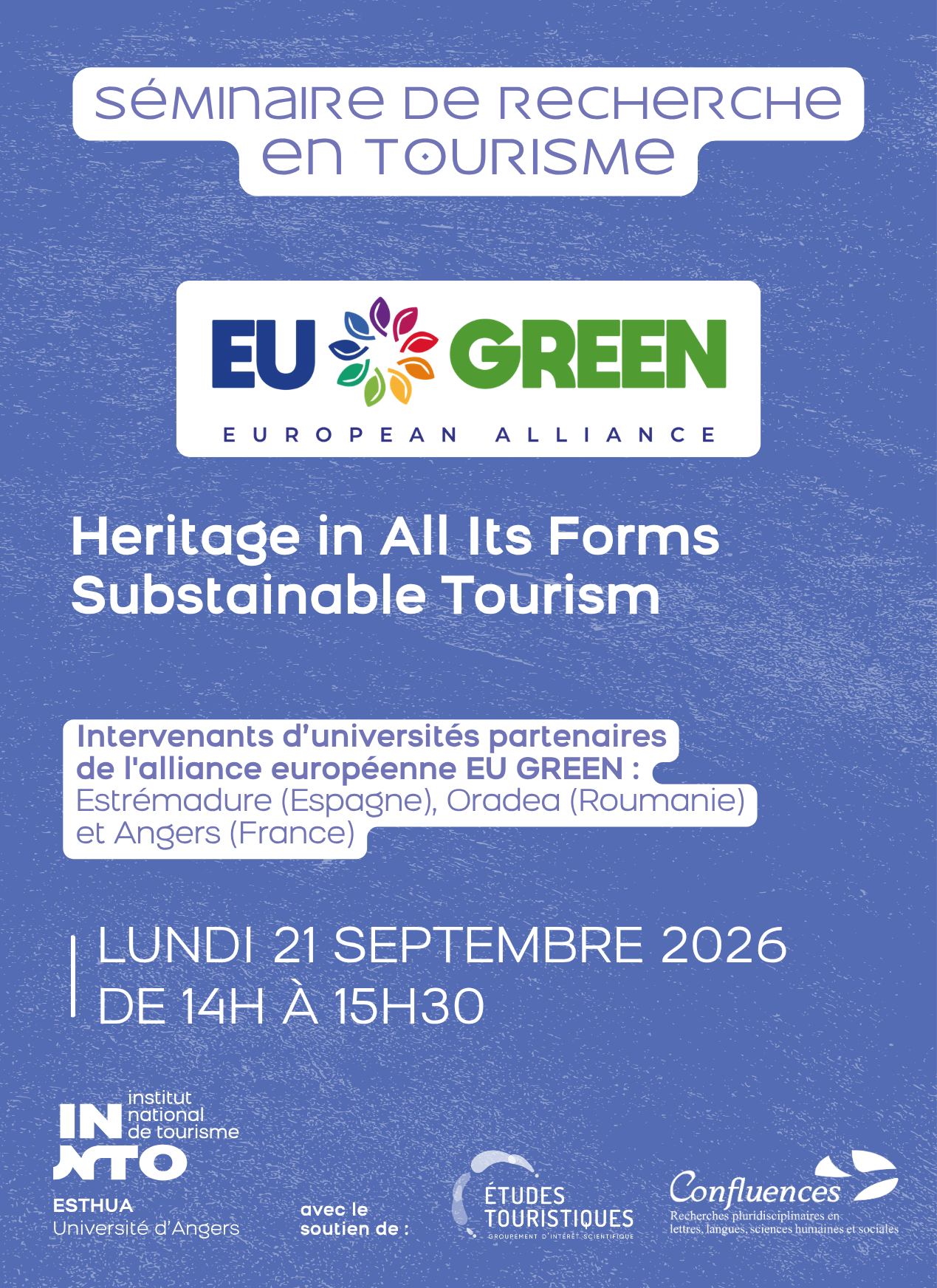
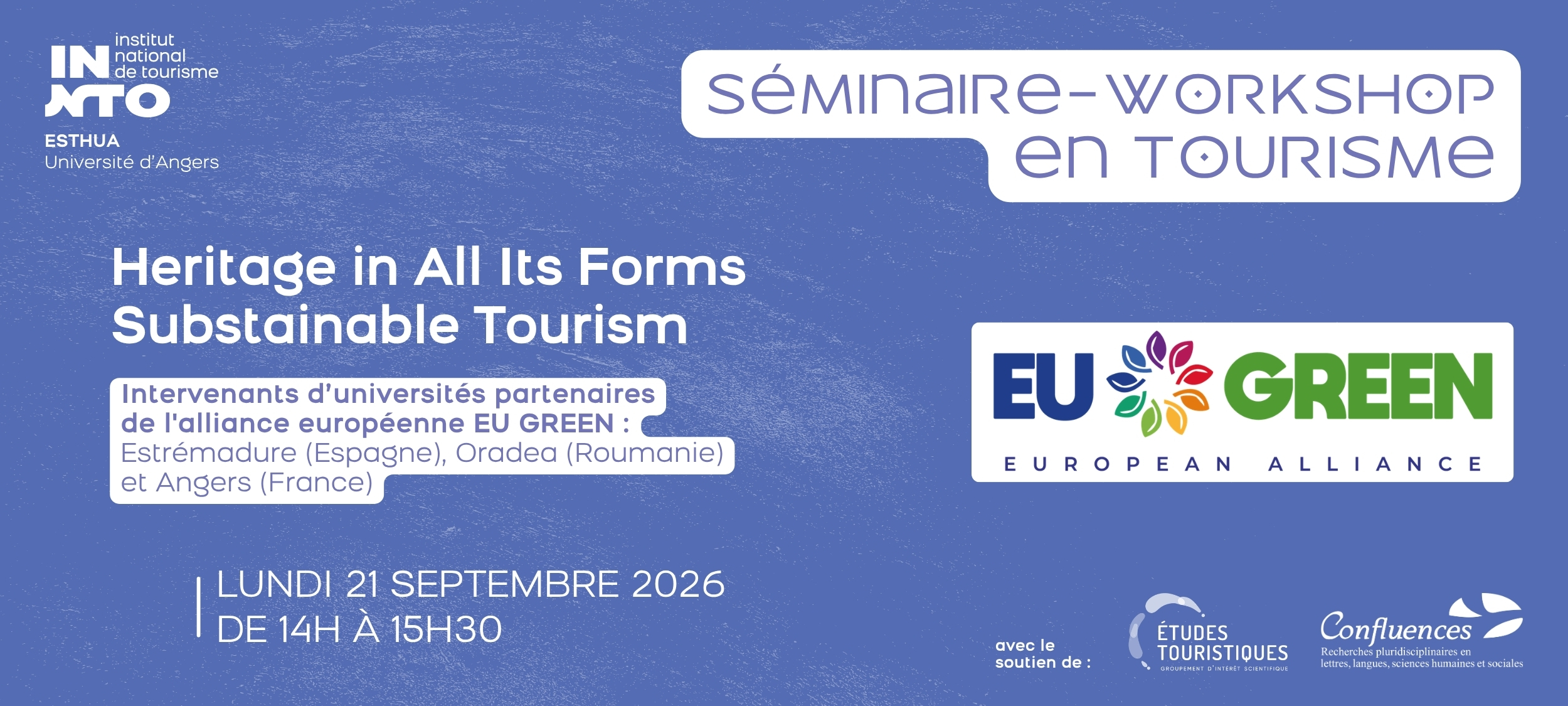
Le prochain Séminaire de Recherche en Tourisme, organisé par l’INNTO Angers – ESTHUA, en collaboration avec l’alliance européenne EU GREEN, le soutien du GIS Études touristiques et de l’axe 5 de la SFR Confluences, aura lieu le lundi 21 septembre 2026, en présentiel et en distanciel, de 14h à 15h30. Le séminaire, qui se déroulera en anglais, aura un format particulier : 3 communications d’universités partenaires d’EU GREEN, avec un temps d’échange final.
Title: From Heritage Conservation to Sustainable Cultural Tourism: Private Investment Mechanisms and P4 Governance in Central and Eastern Europe
Presenter: Alina Badulescu, Economics, Professor at the University of Oradea (Romania)
This paper explores how private capital can support the sustainable development of cultural tourism in Central and Eastern Europe (CEE), a region with rich cultural heritage but limited financial and institutional resources. The study develops an operational typology of investment mechanisms, including public–private partnerships, philanthropy, crowdfunding, and hybrid governance arrangements. Particular attention is given to Public–Private–People (P4) partnerships as instruments for balancing heritage conservation, community participation, and financial sustainability. The analysis combines policy review, international experience, and evidence from Romania, highlighting existing challenges related to funding, governance, and impact measurement. The city of Oradea is presented as a case study of successful heritage-led urban regeneration. Special focus is placed on the adaptive reuse potential of the Viznitzer Synagogue, proposed as a cultural hub supported by mixed financing and performance-based governance. The paper introduces a framework of cultural key performance indicators (KPIs) and payment-by-results mechanisms designed to improve transparency and investment attractiveness. The findings suggest that sustainable cultural tourism can be strengthened through integrated financial mixes, participatory governance, and data-driven management. The proposed model is relevant for medium-sized cities across CEE seeking to transform heritage assets into drivers of local development, cultural vitality, and tourism competitiveness.
Title: The Future of Smart Tourism Destinations: A Strategic Perspective on Social Media Engagement
Presenters:
The future of smart and sustainable tourism destinations depends largely on their ability to manage digital communication and create strategic engagement with their audiences through social media. This study presents a systematic review of the international literature on the relationship between engagement, digital platforms, and tourism dynamics, identifying the main trends and research gaps in the current body of knowledge.
Beyond a theoretical overview, the findings show that visual content and user-generated content (UGC) are the main drivers of online interactions. However, there is still limited research from the perspective of destination managers and institutional governance. Therefore, this study proposes a shift toward a more holistic approach that combines advanced technologies with the active participation of different stakeholders, including local governments and residents.
Finally, the Tourism Model for Engagement Adoption (MOTEA) is presented as a forward-looking framework to guide future digital communication strategies and support more sustainable, coordinated, and adaptive tourism development in response to the global technological changes that are reshaping the tourism industry.
Title : Tourism as an agent of reinvention for European equestrian intangible heritages: The case of three great public Classical Riding Schools
Presenter: Sylvine Pickel-Chevalier, Geography, Professor at the University of Angers (France)
Europe is a melting pot of equestrian traditions, combining national characteristics with a common heritage. However, science and technical progress weakened the centuries-old use of horses in the 20th century. They survived modernity by being re-codified as a source of sport and leisure in an emerging consumer society. Faced with such changes, the question of the survival of classical riding traditions arises. Different public schools in Europe intend on maintaining these traditions. To do so, they must demonstrate their capacity to transmit ideas of classical riding to a large community, addressing both specialists and the general public. In this context, they have taken the initiative of combining the training of students and tourism activities.
The objective of my study is to assess their capacity to conserve the intangible heritage of classical riding in modern society, through this double strategy of transmission, focusing especially on: the Cadre Noir de Saumur in France; the Real Escuela Andaluza del Arte Ecuestre of Jerez de la Frontera in Spain and the Escola Portuguesa de Arte Equestre of Lisbon in Portugal. In doing so I will elaborate on the construction of intangible heritage, including the (re)invention of traditions, and the role of tourism in this process.
My methodology is based on a structuralist constructivism approach, combining literature review, statistical studies, qualitative observations conducted at the three sites and qualitative interviews with 48 people involved at different levels in the conservation of local equestrian heritage, conducted between February 2019 and January 2020. The results were published in a scientific journal in 2020 and give me also the possibility to publish a whole book in 2022, focusing on the inter-construction between tourism and equestrian European heritage in 2022 (ISTE edition).
Le séminaire se déroulera en mode hybride :
Pour plus d’infos consulter: https://www.univ-angers.fr/fr/acces-directs/facultes-et-instituts/ufr-esthua-tourisme-et-culture/recherche/nos-evenements.html